Reliable wire break detection
How important is wire break detection in a stranding machine and how often do preventable faults occur in rotating machinery?
Mechanical or material-related faults can occur in a stranding machine. Common problems include uneven wire tension, which causes an asymmetrical stress distribution in the stranded product; incorrect lay lengths due to slippage at the capstan; increased bearing wear caused by mechanical imbalances, e.g. of the cradles; and the displacement of the strands or wires within the core or the centre (corkscrew effect). In older machines, the switches and cables used to monitor the pintle locks or the tilt switch (in tubular stranders) are also often prone to faults and cause unwanted downtime.
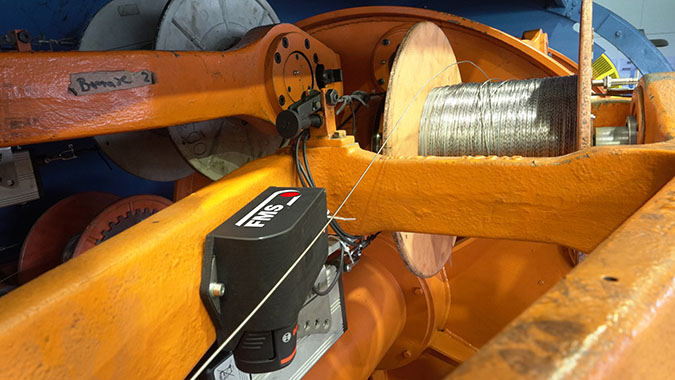
Wire or strand breaks are additional faults that occur regularly. Caused by excessive strand tension, faulty brakes on the pay-offs, feed errors or material defects in the wire, these lead to abrupt breaks. Here are just a few causes:
Excessive strand tension: The capstan is pulling too hard on the wires; excessive unwinding tension.
Incorrect brake adjustment: The bobbins in the cage are being braked too tightly or unevenly.
Material defects: The wire has weak spots, inclusions or cracks resulting from storage or the manufacturing process.
Mechanical friction: The wire runs over sharp edges, worn guide bushings or defective guide rollers.
Centrifugal force: At high speeds, loose wires strike the protective cage and become jammed.
One of the biggest challenges today is the maintenance of older plants, which are prone to breakdowns. Below, we will explain how the FMS-cradleGUARD system can help with modernization.
Why is wire break detection important?
Wire break detection in a stranding machine is important for ensuring product quality, preventing damage to the machine and minimizing the risk of accidents to operating personnel. If a wire breaks unnoticed, a defect is created in the finished rope or cable, which adversely affects – or even completely eliminates – its load-bearing capacity or functionality.
Quality assurance: A missing or broken individual wire leads to defective strands and incomplete ropes; the product is scrapped or will require costly repairs.
Damage prevention: The free end of a broken wire can become entangled in the rotating machinery, wind itself up and destroy components. This can result in costly repairs.
Health and safety: Due to the high centrifugal forces in rotating cages, flying wire ends can cause serious injuries. Shutting down the machine as quickly as possible in the event of a wire break is intended to protect people.
Machine downtime: If the broken strand is pulled through the stranding point, the finished product must be time-consumingly unstranded and the strand reconnected.
Existing systems (mechanical feeler levers, optical sensors or electronic monitoring) are either very simple and therefore inexpensive to purchase, or very complex and consequently expensive. Unfortunately, there is no system that offers reliable performance at a reasonable price.
A different operating principle
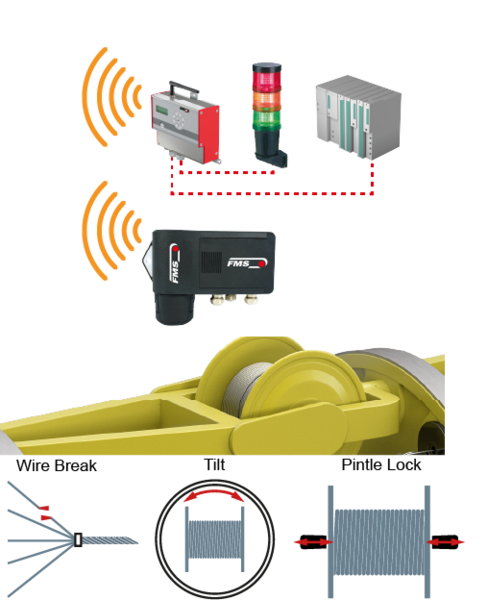
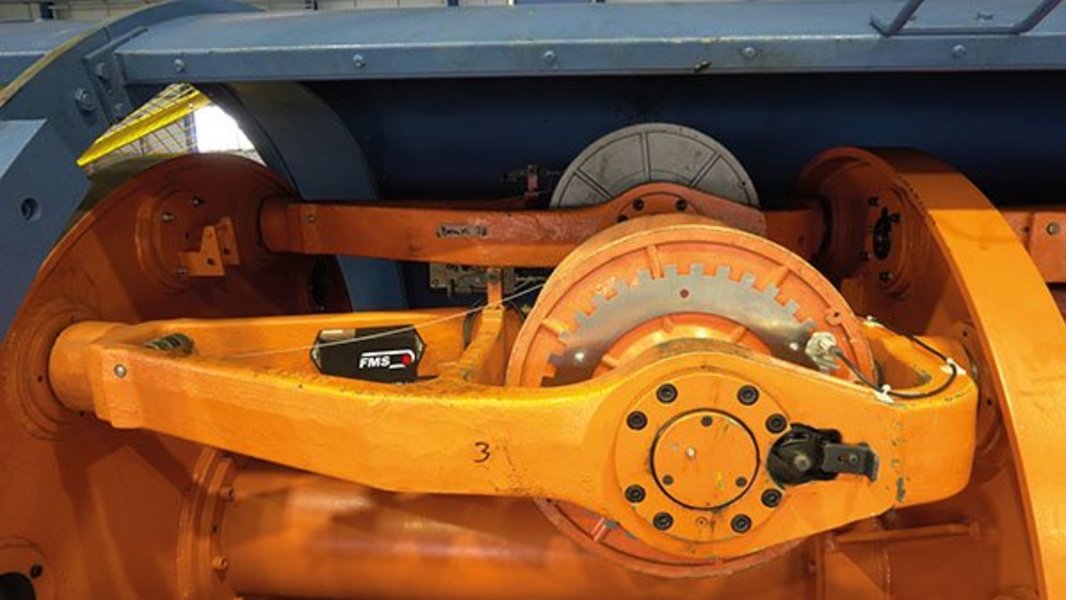
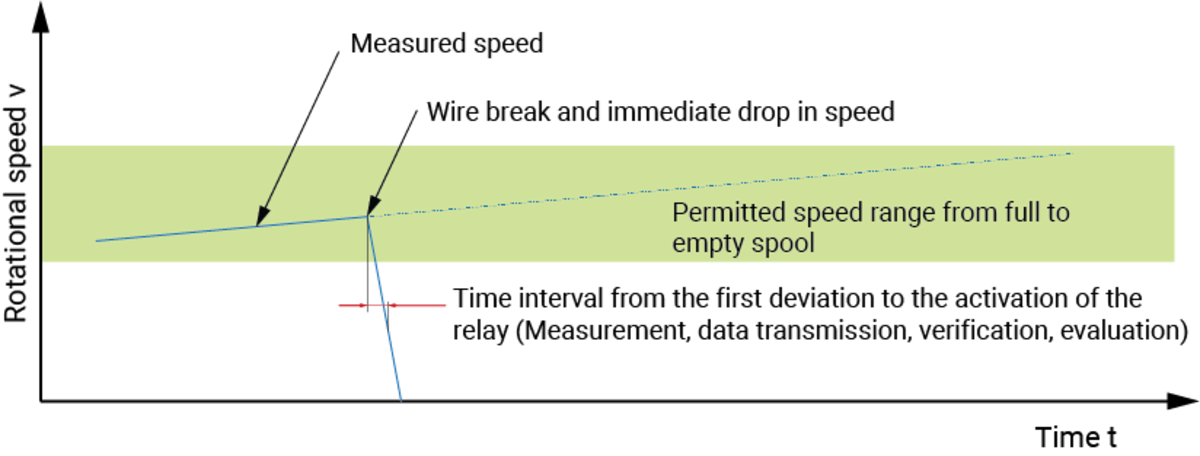
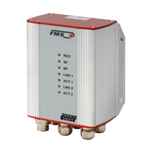
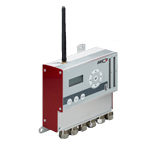
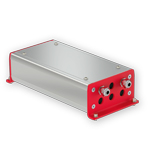
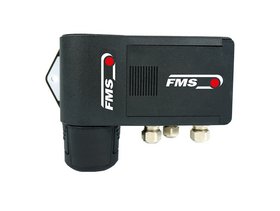
To reliably detect a wire break, the FMS-cradleGUARD analyses the rotational speed of the individual bobbins and compares them with one another and preset thresholds. To do this, we measure the rotational frequency of each unwinder using a gear ring, which is usually attached to the brake disc. The rotation of the bobbin is then detected by a proximity switch and sent to the transmitter module. One transmitter module is required per cradle. Up to 20 such modules per system transmit the respective rotational speeds to the central receiver and evaluation unit. There, by comparing the rotational speeds in fractions of a second, a decision is made as to whether a wire break has occurred. Accordingly, a warning can be sent to the machine operator via relay outputs, or an emergency stop of the machine can be triggered directly.
The system offers unique advantages:
- Reliable wireless transmission; no slip rings required
- Easy to retrofit to existing machines.
- Fault detection, regardless of where the wire break occurs
Initial experiences
The illustrated plant was one of the first to be fitted with the new system. After six months in operation, feedback from machine operators and process engineers confirm the ease of retrofitting and, above all, its reliability in day-to-day operation. The excellent value for money was already a key objective during development and has since been further improved. Thanks to its simplified installation and operation, the FMS-cradleGUARD can be installed and commissioned by the company’s own maintenance and servicing staff.
Wire break detection as an additional feature
- The original function of the FMS-cradleGUARD was to replace fault-prone switches and the associated wiring on the cradles with a wireless system. Consequently, the most common application to date has been the monitoring of pintle locks. Existing switches could generally continue to be used, and their signals were transmitted by radio to the central receiver module. This made it possible to monitor up to 42 individual cradles and to use the signals to alert or inform operating personnel.
In response to customer requests, we have gradually expanded our range. Firstly, we added proximity sensors and tilt switches to our range of accessories. Many customers simply wanted to replace all their old and potentially unreliable components and source them directly from us. The wire break detection function was introduced in the next stage. We were able to draw on our industry experience to eliminate problems with existing systems whilst simultaneously increasing the benefits for the operator. The result is wire break detection as an additional function of the FMS-cradleGUARD. Naturally, we retain the option of continuing to evaluate other sensors (e.g. status of pintle locks).
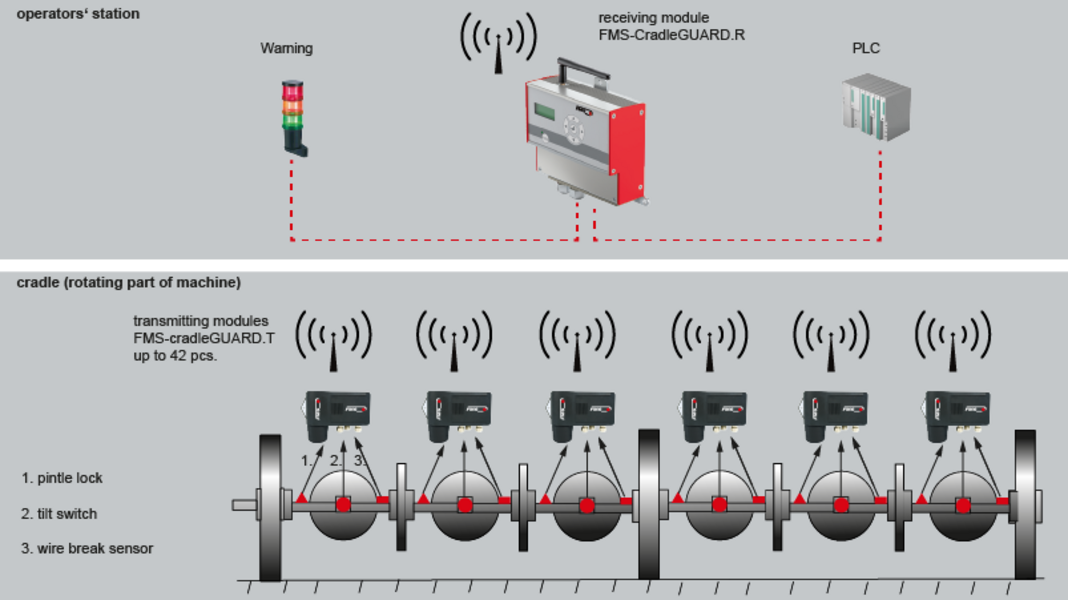
- The wire break detection function was introduced in the next stage. We were able to draw on our industry experience to eliminate problems with existing systems whilst simultaneously increasing the benefits for the operator. The result is wire break detection as an additional function of the FMS-cradleGUARD. Naturally, we retain the option of continuing to evaluate other sensors (e.g. status of pintle locks).